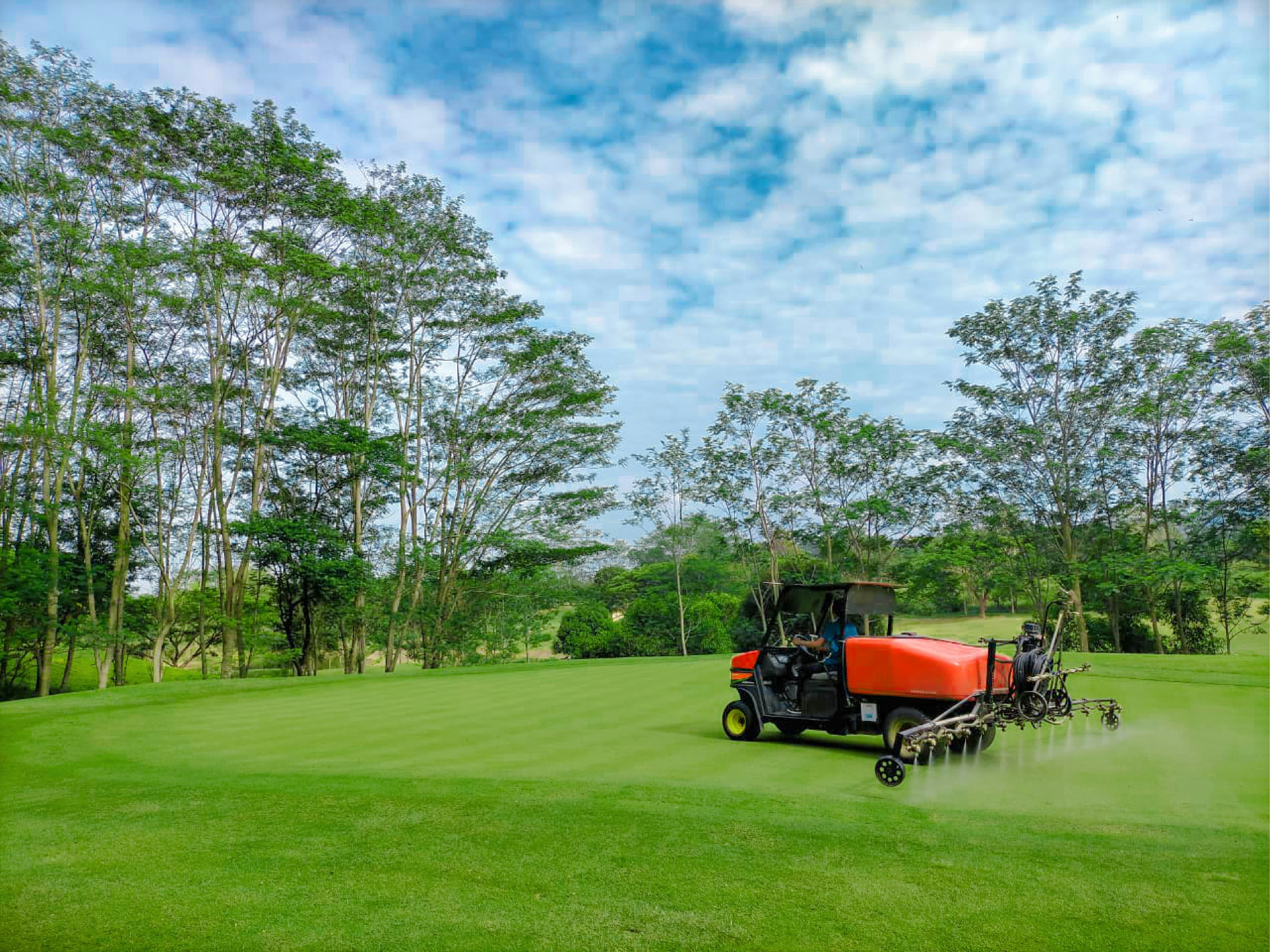
Fertilizing a Georgetown TX lawn correctly requires understanding Central Texas soil chemistry, warm-season grass nutrition needs, and the seasonal windows that make each application effective.
Fertilization is one of the most misunderstood aspects of Georgetown TX lawn care. Walk into any big-box store in Georgetown and you'll find shelves of fertilizer products with conflicting instructions and wildly varying application schedules — none of them specifically designed for Central Texas warm-season grasses.
This guide cuts through the noise and gives Georgetown homeowners a practical, science-based framework for feeding their lawns correctly.
Understanding What Your Lawn Actually Needs
Fertilizer provides three primary nutrients, abbreviated as N-P-K:
- Nitrogen (N): Drives leaf and stem growth; responsible for green color. The nutrient warm-season grasses use most.
- Phosphorus (P): Critical for root development, seedling establishment, and energy transfer within the plant.
- Potassium (K): Improves stress tolerance, disease resistance, and water use efficiency.
On fertilizer bags, these numbers appear as a ratio: 15-5-10 means 15% nitrogen, 5% phosphorus, 10% potassium. The higher the N number, the more aggressively it drives growth.
For established Georgetown lawns on clay soils, phosphorus needs are typically low — Georgetown's clay soils often test high in phosphorus already. A soil test (available through the Texas A&M AgriLife Extension for about $12) reveals your actual soil chemistry and can save you money by telling you which nutrients to apply and which to skip.
Nitrogen: The Critical Variable for Georgetown Lawns
Nitrogen is the nutrient Georgetown lawns use most and the one that requires the most careful timing and rate management.
Too little nitrogen: Pale, thin turf. Slow recovery from stress. Poor competition against weeds.
Too much nitrogen, especially in summer: Soft, lush growth that's susceptible to disease and chinch bug damage. Potential burn in extreme heat. Encourages excessive mowing frequency.
Wrong timing: Nitrogen applied too early (before green-up) in Georgetown is largely wasted — the dormant grass can't use it, and spring rains wash it away. Nitrogen applied too late in fall goes into cold, slowing soil with minimal uptake.
Slow-Release vs. Fast-Release Nitrogen
Fertilizer products are formulated with either fast-release (water-soluble) or slow-release (polymer-coated or organic) nitrogen sources — or a blend.
Fast-release nitrogen (urea, ammonium nitrate) delivers nitrogen quickly, produces rapid green-up, and is less expensive. It also has a short effective window (2–4 weeks), higher burn risk in summer heat, and greater leaching risk on Georgetown's sandy or sloped areas.
Slow-release nitrogen (polymer-coated urea, IBDU, sulfur-coated urea) feeds the lawn gradually over 6–12 weeks. More consistent results, lower burn risk, better for Georgetown's summer applications.
For summer applications in Georgetown (June–August), slow-release or blended products are strongly preferred. For spring applications (March–April), either works well.
The Georgetown Fertilization Calendar
Late February to March: First Application
Apply when your lawn shows clear green-up — at least 50% of the turf is actively growing. Do not apply to dormant grass.
This application should be nitrogen-forward to fuel spring growth. Rates: 0.5–1 lb actual nitrogen per 1,000 sq ft.
May: Second Application
4–6 weeks after your first application. Fuel the rapid growth of late spring.
This is also a good time for a split application — half the nitrogen now, half 4 weeks later — to avoid excessive growth in Georgetown's heating May temperatures.
July: Mid-Summer Application
Use a slow-release product. Apply at moderate nitrogen rates (0.5 lb per 1,000 sq ft). This is not the time for aggressive fertilization — you're maintaining, not accelerating.
Don't fertilize when: soil is drought-stressed, temperatures exceed 100°F for multiple consecutive days, or your lawn is showing signs of disease. Stressed turf cannot absorb and use fertilizer effectively and is prone to burn.
September: Fall Application
The most strategically important application of the year. See our fall lawn care guide for details. Use a balanced or potassium-elevated product.
Optional: October Potassium Application
A standalone potassium application in October hardens tissue for winter. Particularly beneficial for Georgetown lawns that experienced significant summer stress.
Reading Fertilizer Bag Math: A Georgetown Homeowner's Guide
A common confusion: "How much do I apply?"
Fertilizer rates are typically measured in pounds of actual nitrogen per 1,000 square feet — not pounds of product per 1,000 square feet.
Example: You have a 32-0-10 fertilizer. You want to apply 1 lb of actual nitrogen per 1,000 sq ft.
- The bag is 32% nitrogen, meaning 32 lbs of actual N per 100 lbs of product.
- To apply 1 lb of actual N per 1,000 sq ft, you need 100/32 = 3.125 lbs of product per 1,000 sq ft.
- If your lawn is 5,000 sq ft, you need 5 × 3.125 = 15.6 lbs of product total.
This math applies to every bag of fertilizer. The label also usually includes a "coverage area" if applied at the recommended rate — though those recommendations aren't always calibrated for Georgetown's specific soil conditions.
Fertilization Mistakes Georgetown Homeowners Make
Applying in dormancy: Fertilizer applied to dormant Bermuda in December or January sits in the soil until spring, when it may leach away before the grass can use it. Wait for green-up.
Skipping fall fertilization: The most common mistake. Fall fertilization is worth more per dollar spent than almost any other lawn care investment in Georgetown.
Watering too little after application: Granular fertilizer needs to be watered in within 24–48 hours of application (or applied before rain). Granules sitting on dry grass in Georgetown's summer heat can cause foliar burn.
Using the same product year-round: A product designed for spring stimulation is not appropriate for summer or fall. Formulations matter for each season's goals.
If you want a fertilization program managed by professionals who understand Georgetown's soil and seasonal conditions, our lawn care packages include a coordinated seasonal fertilization schedule as part of your program.